Our origin · Northern Ireland
From a divided place came an idea about one world.
IOWL was conceived in Belfast. The Giant's Causeway gave the Institute an enduring visual metaphor: distinct parts, strongly formed, connected into something greater.
The story behind the Foundation Stone ↓
Belfast · Basalt · One World
The landscape is not decoration. It is part of the idea.
The Institute's beginnings and the first Positive Value Leadership framework are rooted in two Northern Irish realities: the experience of division, and a landscape whose strength comes from interconnected structure. Together they shaped an enduring question: how do people exercise influence in ways that strengthen, rather than diminish, the world around them?
01 · Where the question began
Belfast made leadership impossible to regard as an abstract idea.
The Institute of One World Leadership was founded in Northern Ireland, where its central idea first took shape. IOWL's founder, Noel Ferguson, was born and raised in Belfast during the Northern Ireland conflict. Division was not theoretical: it was visible in communities, institutions and everyday life.
In his early twenties, an international management career brought sustained exposure to different countries, cultures and ways of living. The contrast mattered. Against memories of segregation and division at home came a growing recognition that human difference and human commonality coexist — and that living and working well across those differences requires more than knowledge, position or technical capability.
The Institute was founded around that proposition. Leadership had to include values, responsibility, the effect we have on others, and the ability to work across boundaries. Positive Value Leadership became the first formal expression of that thinking.
One World was never a claim that the world is uniform. It is the recognition that difference exists within one shared world — and that how we exercise influence within it matters.
THE FOUNDING QUESTION
What should sit alongside capability?
Skills and knowledge tell us what a person may be able to do. IOWL's work began with the additional question of how that capability is exercised: with what values, judgement, awareness of others and effect on the wider world.
THE NAME
One World Leadership
The name reflects interdependence rather than sameness. The OWLs identity also carries the association of the owl with observation, learning and wisdom: the capacity to look carefully before acting.
02 · The Foundation Stone
The Causeway offered a natural metaphor for responsible influence.
The Giant's Causeway contains around 40,000 interlocking basalt columns, formed as ancient lava cooled and fractured into the geometry for which the landscape is known. What mattered to IOWL was not geology for its own sake, but what the structure suggested.
Each column is distinct. None exists in isolation. Together they create extraordinary strength and continuity. The hexagon therefore became the visual language of the original Positive Value Leadership framework — a way of expressing the idea that individuals are formed in relationship with others, and that behaviour can propagate through teams, organisations, communities and society.
01
Distinct
Individual identity and difference are preserved rather than erased.
02
Connected
People act within systems of relationships, consequence and influence.
03
Consequential
What one person models can strengthen — or weaken — what forms around them.
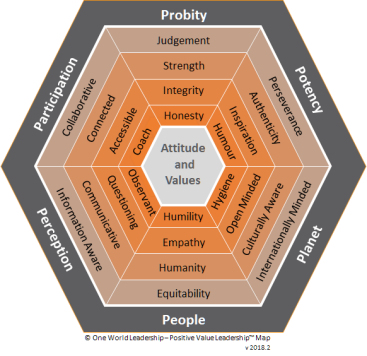 The original architecture
Positive Value Leadership
The Foundation Stone translated the six-sided geometry into an applied framework for the values, traits and behaviours through which influence is exercised.
The idea grew. The founding logic remained.
Positive Value Leadership was the foundation, not the end point. IOWL's work has developed into a wider architecture concerned with calibre, responsible judgement, integrity, reflective transformation and the perpetual development of the person across education, work and life.
01 · FOUNDATION STONE
Positive Value Leadership
Made values and their expression visible through a structured framework: Probity, Potency, Planet, People, Perception and Participation.
02 · CALIBRE
Beyond what a person can do
Extended the question from capability alone to the quality of judgement, character and conduct with which capability is exercised.
03 · PCD
Perpetual Calibre Development
Recognises that calibre is not a one-off educational outcome. It must continue to be developed, reflected upon, evidenced and renewed over time.
04 · MY WORLD
One person. One World.
Provides the individual with a persistent place to develop, evidence and carry that journey across learning, work, professional standing and wider life.
What has not changed
Capability matters. So does the calibre with which it is applied.
The terminology, evidence base and systems have become more sophisticated, but the proposition at the centre of IOWL remains recognisable from its beginnings in Belfast: people affect the conditions around them. Responsible judgement, integrity and awareness of consequence therefore matter alongside knowledge, skill and experience.
Continue the journey
From our Foundation Stone to the architecture IOWL is building today.
Explore Perpetual Calibre Development, enter My World through Aspirant Access, or start an institutional conversation about how the thinking can be applied.
Explore Perpetual Calibre Development Enter My World Start a conversationGlobal Centre · Custom House, Custom House Square, Belfast BT1 3ET, United Kingdom